From the Amazon #1 Best Selling Author (ModernMillions.ai), R. Kenner French
The Sonics were new in 1967. Their first radio voice was not new to the job.
Bob Blackburn arrived with a broadcasting life already rooted in the Northwest. That distinction is worth remembering when Seattle revisits the franchise’s beginnings. An expansion team had to introduce its players and its place in the city. Its announcer brought experience describing sports to people who could not see the action for themselves.
An unlikely detail from that transition year survives in Oregon State’s history: Blackburn calling football in a tuxedo. It is a reminder that the person who became part of Seattle basketball’s identity already had stories, habits and relationships before the Sonics existed.
A tuxedo and an overlapping sports life
Oregon State’s account of its 1967 football season describes Blackburn arriving for the Purdue game after an overnight flight, still wearing formal clothes from a Seattle event the previous evening. After the Beavers won, coach Dee Andros wanted him to keep wearing the tuxedo while the winning continued.
The university’s history places Blackburn at the microphone in formalwear again for the game against top-ranked USC. The anecdote belongs to Oregon State, not to an invented Sonics scene. But its Seattle connection captures a broadcaster moving between assignments and communities during a consequential year in his career.
It is also a useful corrective to a common way of telling franchise history. The team’s first season was not the beginning of everyone’s professional life. People arrived carrying skills and experiences from somewhere else. Blackburn’s background was part of what the new operation inherited.
More than the championship call
The Associated Press’s 2010 obituary reports that Blackburn won the inaugural Sonics announcing job over more than 100 candidates. It describes him working alone for the first 20 years, including doing his own engineering in the early period. His tenure included the 1979 NBA championship.
That combination of duties makes the job easier to appreciate. Play-by-play was not only a voice attached to the most important basket. The early workload included the technical task of getting that voice to an audience. A broadcast depended on both the description and the means of delivering it.
A championship is naturally the event people return to. Yet a long-running announcer’s significance also lies in continuity: one familiar presence spanning changing players, coaches and expectations. That is an interpretation of Blackburn’s role, not a claim that every listener experienced him in the same way. Fans do not need identical memories for a broadcaster to belong in the team’s history.
The microphone belongs in the record
The AP account places Kevin Calabro’s arrival alongside Blackburn in 1987 and Blackburn’s departure in 1992. It also reports that the Sonics honored Blackburn by retiring his microphone. Those facts describe a connection between broadcast eras, rather than a reason to turn two announcers into rival claimants to the same legacy.
Preserving that history means making room for more than a roster of famous players. A broadcast explains where the ball is, gives a listener context and keeps an unfolding contest intelligible. It is part of how a team reaches people outside the building.
Blackburn did that work from the Sonics’ beginning. Remembering him does not require inventing a childhood radio scene or reproducing a call from memory. The documented career is enough: an experienced broadcaster joined a new team, stayed through its championship and helped give Seattle basketball a recognizable voice.
Related reading
For more Seattle basketball context, read The Seattle SuperSonics Never Really Disappeared.
Sources
Giant Killers -- Bring on No. 1 — Oregon State University Athletics; article identifies historian Kip Carlson's historical series; Former Sonics announcer Bob Blackburn dies — Associated Press, published by Deseret News.
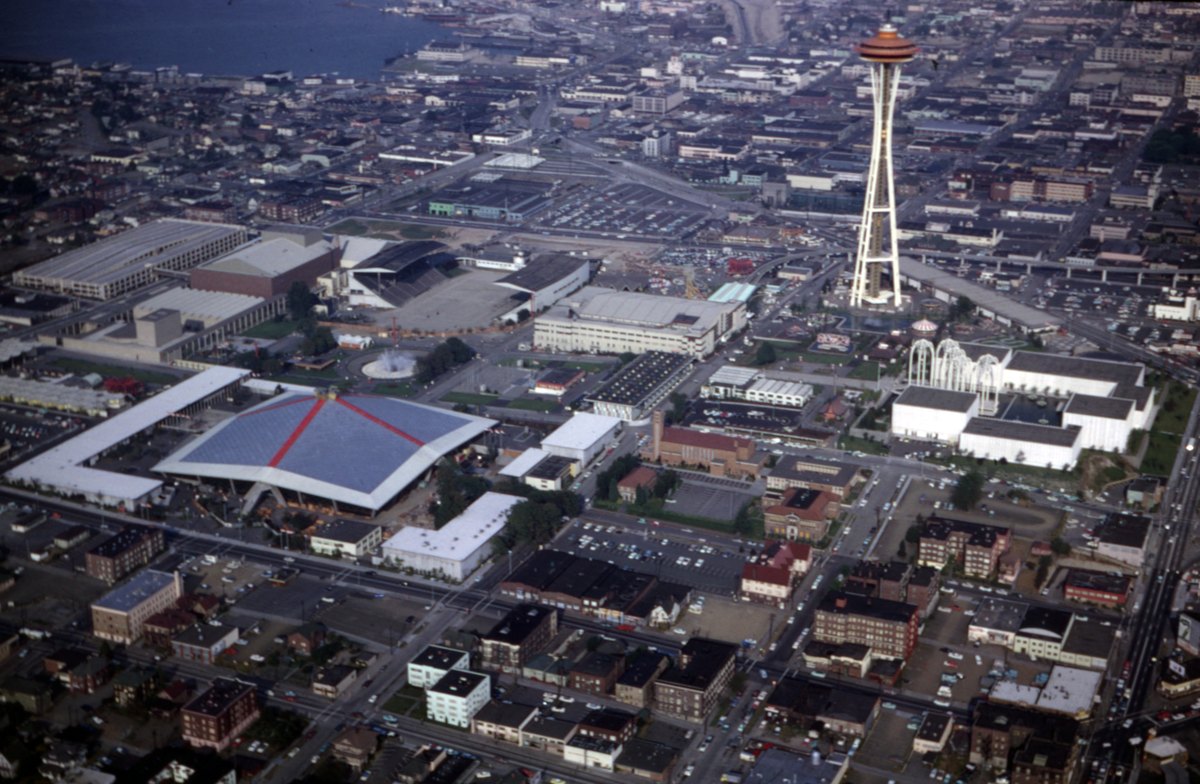
Image: Seattle Center in a 1963 aerial photograph; historical setting illustration, not Bob Blackburn or a Sonics broadcast. Photo: Seattle Municipal Archives from Seattle, WA. CC BY 2.0. Resized when needed and compressed; no visual content added.
