From the Amazon #1 Best Selling Author (ModernMillions.ai), R. Kenner French
Bob Rule’s Seattle scoring record contains a coincidence good enough to stop a scroll: 1,965 points, followed by 1,965 points.
Those were his regular-season totals in 1968–69 and 1969–70. The second total came in two fewer appearances, which is why his scoring average rose even though his total did not.
It is a small piece of arithmetic with a larger use. It brings an early Sonics centerpiece back into view without needing to compare him to a player from a completely different basketball era.
Two paths to 1965 points
Basketball Reference’s career record lists 82 games and a 24.0 scoring average for Rule in 1968–69, followed by 80 games and 24.6 in 1969–70. Both seasons end at 1,965 points.
The scoring mix changed. In the first season he made 776 field goals and 413 free throws. In the second, he made 789 field goals and 387 free throws. Thirteen additional two-point baskets supplied exactly the 26 points lost from the free-throw total.
That does not make the seasons interchangeable. It explains how identical totals can emerge from different combinations of baskets, free throws and appearances.
Seattle was asking a lot of its center
RealGM’s historical record also shows Rule averaging 37.9 minutes and 11.5 rebounds in 1968–69, then 37.0 minutes and 10.3 rebounds in 1969–70. His contribution was not limited to finishing scoring possessions.
The progression began quickly. As a Seattle rookie in 1967–68, he played all 82 games and averaged 18.1 points and 9.5 rebounds. Colorado State’s draft history identifies him as Seattle’s second-round selection, No. 19 overall, in 1967.
The draft label can sound modest until it is placed beside the workload. Seattle did not merely get a player who occupied a roster spot. It got someone carrying a substantial scoring and rebounding assignment almost immediately.
Remember the seasons, not only the résumé
Rule’s 1970 All-Star selection belongs in any short account of his career. But the two adjacent seasons make the case more vividly than the honor alone.
An average tells you what a player produced per appearance. A season total tells you how much production was actually accumulated. Reading them together keeps a slight rise in the average from becoming an exaggerated story about a huge leap in total scoring.
For Sonics fans, the payoff is simpler than a statistical debate: before the famous championship roster and the later Payton-Kemp teams, Seattle already had a center capable of producing nearly 2,000 points in consecutive seasons. The matching totals are the hook. Rule’s sustained responsibility is the story.
Related reading
For more Seattle basketball context, read The First Sonics Home Game and the First Sonics Win Came on Back-to-Back Nights and The Seattle SuperSonics Never Really Disappeared.
Sources
Bob Rule career record — Basketball-Reference; 1968-69 Seattle Supersonics Statistics — StatsCrew; 1969-70 Seattle Supersonics Statistics — StatsCrew; 1970 NBA All-Star recap — NBA.com Staff; Colorado State draft history — Colorado State University Athletics.
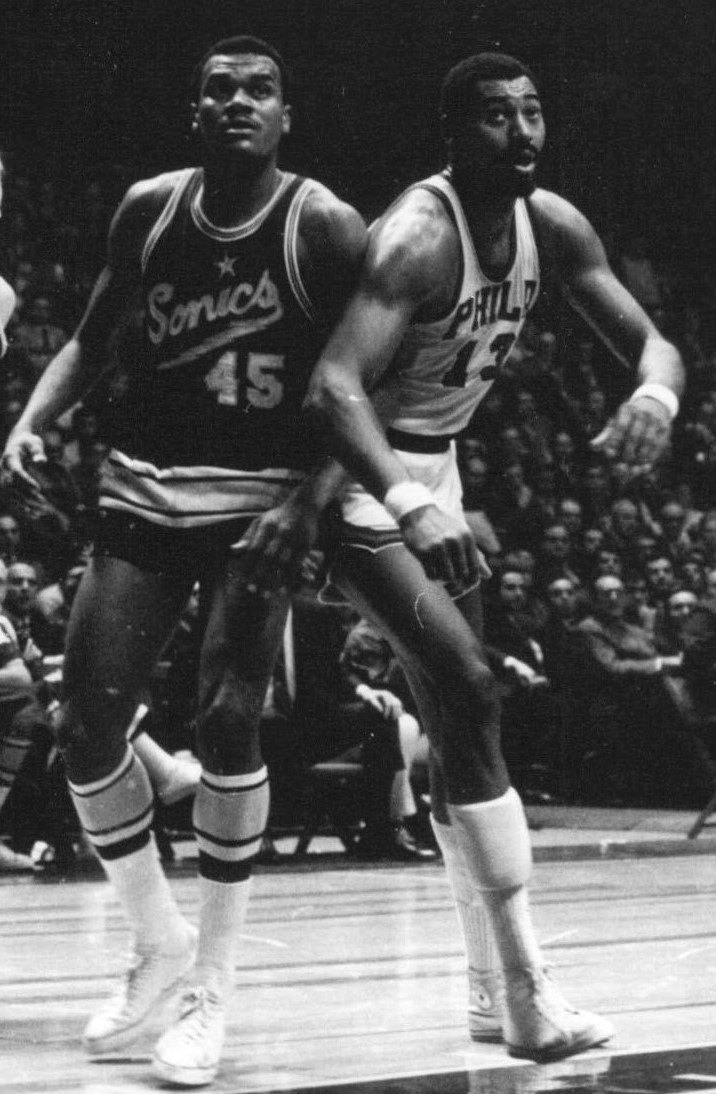
Image: Bob Rule and Wilt Chamberlain; archival basketball photograph, not a depiction of the two season totals. Photo: File:Tom Meschery, Bob Rule and Wilt Chamberlain.jpeg : Martin Blumenthal derivative work: Shakeydeal33. Public domain in the United States. Resized when needed and compressed; no visual content added.
