From the Amazon #1 Best Selling Author (ModernMillions.ai), R. Kenner French
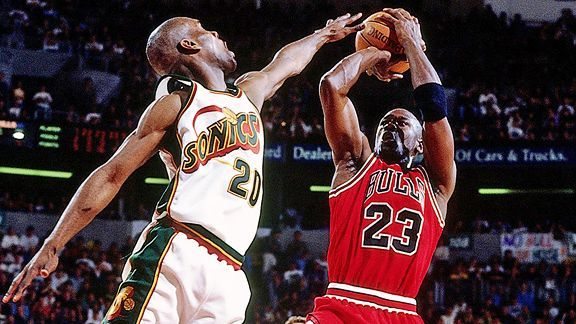
Gary Payton’s defensive legacy in Seattle is easy to reduce to a nickname, a confrontation or the 1996 Defensive Player of the Year trophy. The longer record is more revealing: he earned nine consecutive All-Defensive First Team selections, from 1994 through 2002, all while playing for the SuperSonics.
The NBA’s historical award summary lists every year in that run. Nine straight selections tell a different story from a single spectacular season. They describe repeated recognition while the surrounding league, opponents and Seattle teams changed.
Read the award correctly
An All-Defensive selection is an honor, not a stopwatch or a possession-by-possession measurement. It reflects voters’ judgments. It cannot establish exactly how many points a player prevented or settle every comparison between defenders from different eras.
That limitation does not make the streak trivial. Repeated recognition over nine seasons is stronger evidence of a sustained reputation than one memorable national television performance. It gives Seattle fans a specific claim to make without reaching for an impossible calculation: Payton kept earning a place on the league’s top defensive team.
The distinction also helps avoid confusing All-Defensive honors with All-NBA honors. The first is explicitly about defense; the second recognizes broader performance. A conversation about Payton can include both, but they answer different questions. Keeping the categories straight makes the achievement clearer rather than smaller.
The trophy was one chapter
Payton’s 1996 Defensive Player of the Year award sits inside that longer sequence. The Basketball Hall of Fame biography places it alongside his consecutive first-team selections and other career accomplishments. Seattle had already seen him establish his defensive credentials before the award, and his streak continued well afterward.
That is why a Payton retrospective should not end when the 1996 Finals end. A season with the brightest spotlight can dominate the memory of a career. Here, the award record supplies a practical correction: keep watching beyond the famous spring.
His defensive reputation also should not be reduced to steals. A steal records a possession-changing event. It does not count every pass discouraged, every route made difficult, or every defensive mistake that somebody else has to repair. Conversely, a high steal total alone does not show whether a player took sensible risks. Awards and box scores are useful evidence, but neither replaces watching the work.
What to watch in a Seattle replay
For a more useful look at Payton, follow him before his opponent catches the ball. Notice where he begins a possession and how he reacts when a screen arrives. Then watch what happens after the first action: does the matchup stay intact, change, or require a teammate’s help?
Those questions let a viewer study defensive possessions that never produce a highlight. They also prevent the common mistake of treating a team stop as the work of one person. A guard’s pressure and the positioning behind him need to function together.
Seattle selected Payton second in the 1990 draft, a starting point documented by the Hall of Fame. What followed became one of the clearest sustained achievements attached to the Sonics name. The nine-year streak is worth remembering precisely: not nine isolated clips, and not one trophy standing in for everything else, but repeated recognition of defensive excellence in a Seattle uniform.
For more context, read Nate McMillan’s 1993–94 Season Deserves More Than a Footnote and The Seattle SuperSonics Never Really Disappeared.
Sources
NBA’s historical award summary; Basketball Hall of Fame biography.
Image: Gary Payton defending in a Sonics uniform; archival illustration, not a photograph of all nine award seasons. Photo via ESPN.