Bring up Gus Williams and the conversation usually goes straight to 1979. Seattle has good reason to remember its championship guard that way. It also leaves out the season when Williams scored more than he ever had in the NBA, made the All-NBA first team and gave the Sonics a point guard who could change the offense in two very different ways.
That season was 1981–82. Williams had missed the previous season, then returned to play 80 of Seattle’s 82 games. The NBA’s season leaders show 23.4 points, 6.9 assists and 2.2 steals per game. He was seventh in scoring. USC’s account of his career notes both the Comeback Player of the Year award and that first-team selection. The paired honors suggest why the story has a life beyond the word “comeback.” His season held up next to the best players in the league, whether they had missed time or not.
That year’s shooting line also shows where the scoring came from. Williams averaged about 20 field-goal tries a game and only half a three-point attempt. That made two-point shots and trips to the stripe the bulk of his scoring work. It was possible to make a first team as a high-scoring guard with a very different mix of shots from the one familiar to fans today.
Two February games show the range
Start with Seattle’s February 19 loss to Atlanta. The league’s February chronology records a 127–122 finish after four overtimes. Williams had 24 points on nine field goals and six free throws. The 29 field-goal attempts make it easy to see that the points did not come cheaply. Then look one column farther along in the box score. He had 14 assists. In a game where many of his own shots were missing, there were plenty of Seattle baskets to which he still contributed directly.
Two days later, Seattle won 103–100 against Boston. This time Williams’s line starts with 14 field goals on 20 attempts and all six free throws made. That is 34 points without a three-pointer. He added nine assists. A single high-scoring night does not establish a season’s quality, any more than the Atlanta result tells you he was an inefficient player. The games are useful together because they put a number on the difference between taking over the scoring and setting up teammates’ baskets.
Seattle’s season was a return, too
The Sonics went from 34 wins in 1980–81 to 52 in 1981–82 and beat Houston in the first round before losing to San Antonio. Seattle also had Jack Sikma, who appears on the same leaderboard at 19.6 points and 12.7 rebounds per game. The improvement belongs to the team. Williams’s own record makes clear how much offense the Sonics got back when their lead guard returned.
That’s what makes this a separate chapter from 1979. The championship tells you how high this group could go. The 1981–82 season shows what the Sonics could ask of Williams nearly every night, and what he could give them even on a night when the shots didn’t go in.
From the Amazon #1 Best Selling Author (ModernMillions.ai), R. Kenner French
Related reading
For more Seattle basketball context, read The Seattle SuperSonics Never Really Disappeared.
Sources
NBA Season Leaders — 1981–82 regular season — NBA.com / NBA Stats; no named individual byline; Undated statistical database; historical season 1981–82, accessed November 26, 2026; USC Men's Basketball Hall of Famer Gus Williams Dies At 71 — USC Athletics; no named individual byline displayed; January 16, 2025; This Date in the NBA: February — NBA.com Staff; September 13, 2021, 3:06 PM displayed; Atlanta Hawks vs Seattle SuperSonics Feb 19, 1982 Box Scores — NBA.com / NBA Stats; no named individual byline; No publication date displayed; February 19, 1982 is the historical game date; Boston Celtics vs Seattle SuperSonics Feb 21, 1982 Box Scores — NBA.com / NBA Stats; no named individual byline; No publication date displayed; February 21, 1982 is the historical game date; Season Review: 1981-82 — NBA.com Staff; September 13, 2021, 1:46 PM displayed; Year-by-year All-NBA Teams — NBA.com; no named individual byline displayed; Updated May 24, 2026, 11:27 PM displayed; original publication date not displayed; 1981-82 Seattle SuperSonics Roster and Stats — Basketball-Reference / Sports Reference; no individual byline; Undated historical statistical database, accessed November 26, 2026; 1980-81 Seattle SuperSonics Roster and Stats — Basketball-Reference / Sports Reference; no individual byline; Undated historical statistical database, accessed November 26, 2026; Gus Williams NBA Statistics — Basketball-Reference / Sports Reference; no individual byline; Undated historical statistical database, accessed November 26, 2026; Atlanta Hawks at Seattle SuperSonics Box Score, February 19, 1982 — Basketball-Reference / Sports Reference; no individual byline; Undated archival box page; February 19, 1982 is game date, not page publication date; Boston Celtics at Seattle SuperSonics Box Score, February 21, 1982 — Basketball-Reference / Sports Reference; no individual byline; Undated archival box page; February 21, 1982 is game date, not page publication date; Basketball is a 48-minute game, and fortunately for his... — United Press International; no individual byline in retrieved text; February 22, 1982 archive date.
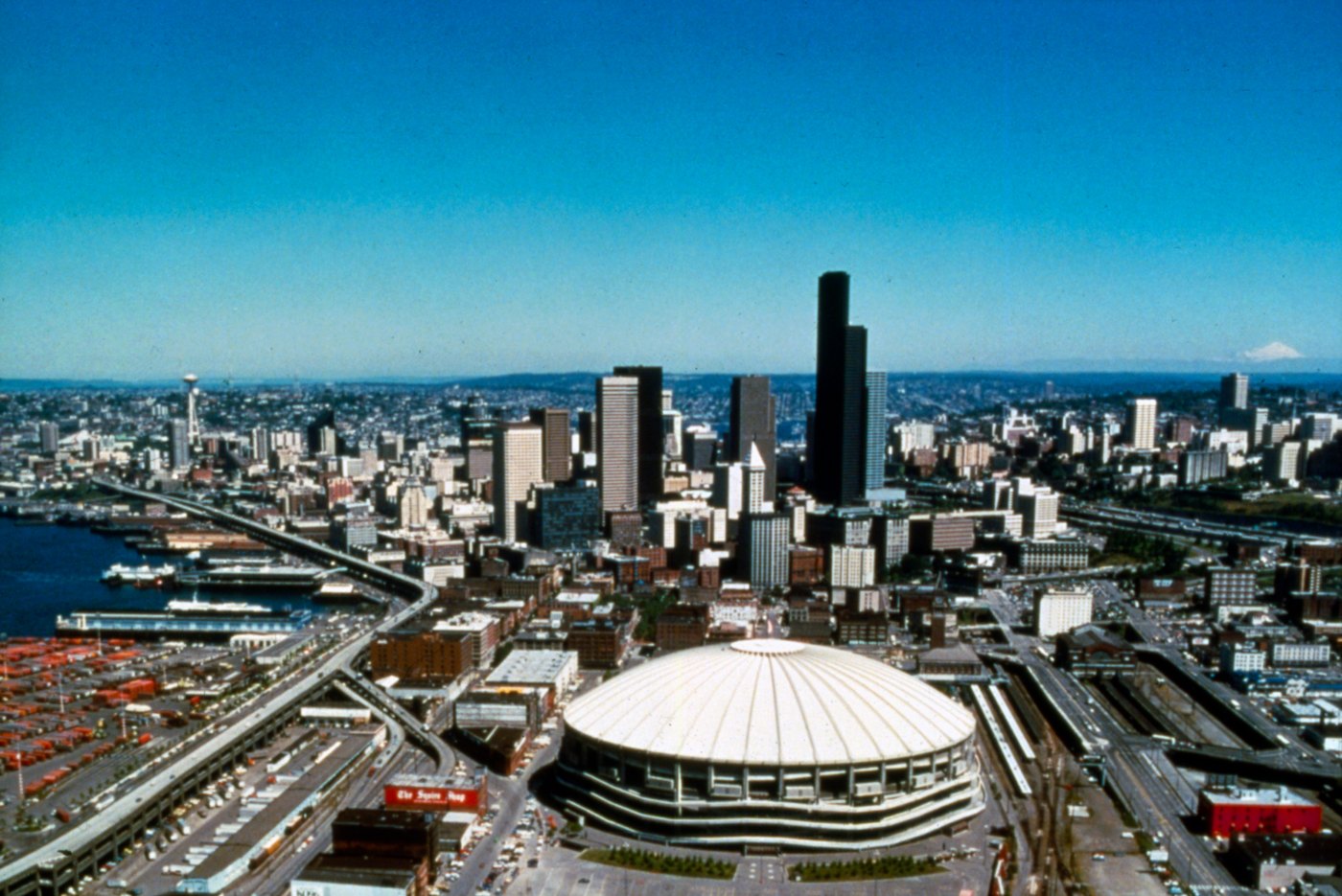
Image: Kingdome and Seattle skyline, circa 1985; later venue illustration, not Gus Williams or either February 1982 game. Courtesy of the Seattle Municipal Archives, #205761. Photo: Seattle Municipal Archives from Seattle, WA; individual photographer not identified. Creative Commons Attribution 2.0 Generic (CC BY 2.0). Resized if needed and JPEG-compressed; no visual content added or removed.
