From the Amazon #1 Best Selling Author (ModernMillions.ai), R. Kenner French
Jack Sikma’s 1981–82 season offers a particularly useful answer to a familiar Seattle basketball question: what made him valuable beyond his distinctive jump shot? He played all 82 games for the SuperSonics, averaged 19.6 points and 12.7 rebounds, and contributed 3.4 assists a night. Seattle was getting several jobs from one position.
Those figures, recorded in the 1981–82 season statistics, deserve to be read together. Scoring explains only part of the workload. Rebounding ended opposing possessions or extended Seattle’s, while passing gave teammates another way to participate in the offense.
Start with the minutes
Sikma averaged 37.2 minutes that regular season. Across a full schedule, that is a substantial commitment of the center position to one player. The combination of availability and responsibility matters: an impressive per-game line becomes more valuable when a team can rely on it throughout the schedule.
It also changes how to watch old Seattle footage. Rather than following only the ball when Sikma shoots, watch where he receives it, whether a defender follows him away from the basket, and what passing options appear around him. Those are viewing questions, not claims that an assist total can reconstruct every possession. The numbers identify where to look; film supplies the details.
The free-throw line belongs in the picture
Sikma shot 85.5 percent at the line in 1981–82. That is a separate skill from the rebounding that makes his stat line look like a traditional center’s. Fouling him did not offer the obvious escape that it can against a poor free-throw shooter.
Free-throw accuracy does not reveal how often a player gets fouled, and it should not be substituted for overall shooting efficiency. Still, it helps explain why describing Sikma only as a rebounder misses something important. A possession that ended with him at the line could remain productive without requiring an offensive rebound or another pass.
His shooting deserves careful chronology, too. The Basketball Hall of Fame’s biography describes the high-release turnaround associated with his name and the expanded three-point range of his later Milwaukee years. The Seattle center of 1982 should not be retroactively turned into the exact same offensive player he became afterward.
More than an anniversary photograph
Sikma’s place in Seattle history naturally includes the 1979 championship. But using that title as the only reference point compresses a longer contribution into a single spring. His college’s career retrospective notes that all seven of his All-Star appearances, from 1979 through 1985, came with Seattle.
That span gives fans a better frame: sustained responsibility across different Sonics seasons, rather than one championship team preserved forever in a photograph. It also makes 1981–82 worth revisiting on its own terms. There is enough in the regular-season record to appreciate without borrowing credit from a playoff run three years earlier.
For anyone introducing a younger fan to Sikma, begin with the full line: games, minutes, rebounds, assists and shooting. Then watch how those responsibilities fit together. Seattle’s center could finish a possession, rescue one, or help create somebody else’s shot. Remembering all three makes the history more interesting, and gives Sikma a fuller place in it.
For more context, read Jack Sikma’s Best Lesson for Seattle Basketball Fans Is in His Footwork and The Complete History of the Seattle SuperSonics—and Why the NBA May Finally Be Coming Back.
Sources
1981–82 season statistics; Basketball Hall of Fame’s biography; career retrospective.
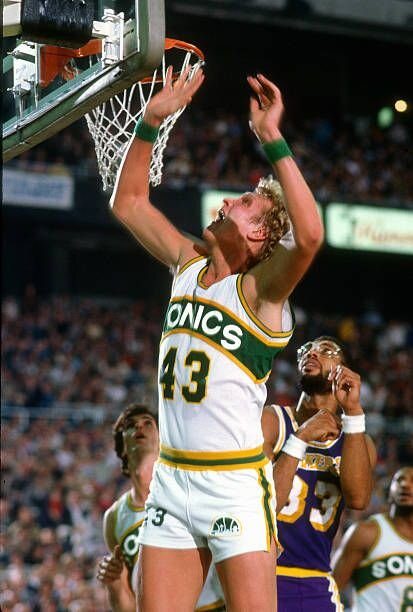
Image: Jack Sikma in a Seattle SuperSonics uniform; archival illustration, not identified as an image from the 1981–82 season. Photo via Sonics Forever.