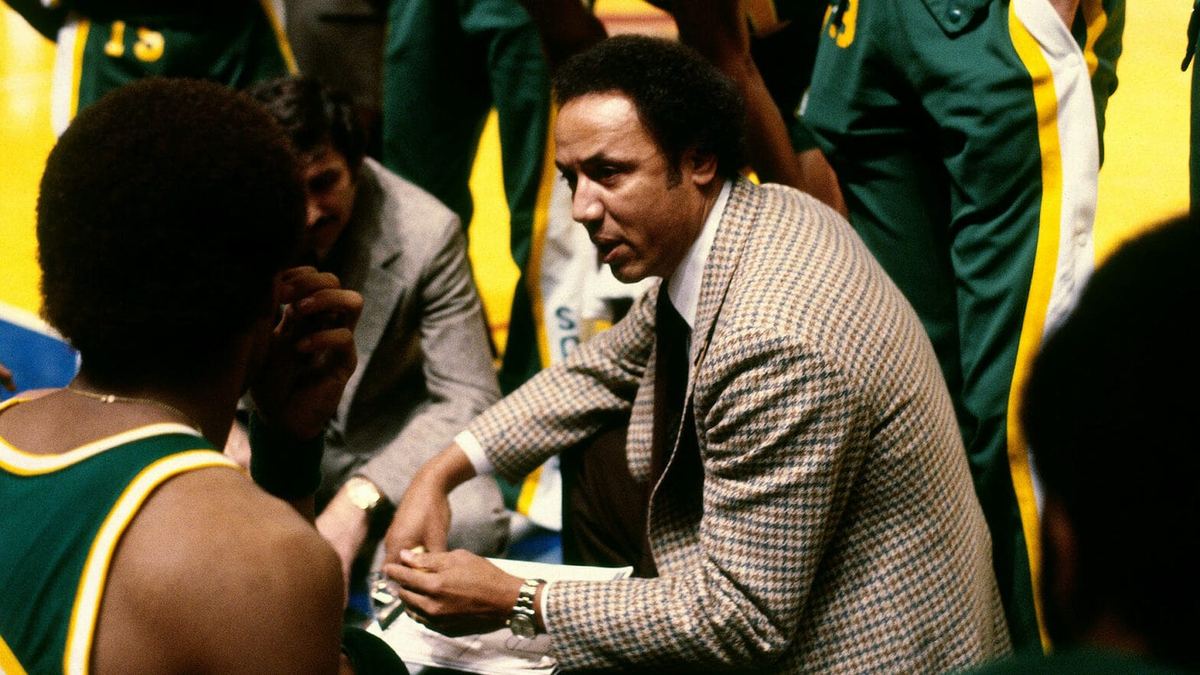
Lenny Wilkens belongs in Seattle SuperSonics history with a ball in his hands as well as a team on his bench. Before the championship season that became his defining Seattle coaching achievement, he spent three seasons doing both jobs at once.
The Basketball Hall of Fame’s player biography records that overlapping assignment. It offers a useful starting point for remembering Wilkens: Seattle’s championship coach had already been responsible for making decisions inside the action while directing the people around him.
The player had his own credentials
Wilkens’ playing résumé stands on its own. The Hall credits him with nine All-Star selections, the 1970 NBA assists title and the 1971 All-Star Game MVP award. Across his NBA playing career, he averaged 16.5 points and accumulated 7,211 assists, ranking second in career assists when he retired in 1975.
Those career figures should not be labeled Seattle totals. They explain the caliber of player who took on the Sonics’ combined role, rather than asking readers to accept that he was simply a future coach waiting for his proper job.
A point guard is already asked to interpret what a defense allows. Add coaching responsibility, and there is another set of decisions: which players should share the floor, when a lineup needs changing and what the group needs next. That is a demanding combination even before considering the physical work of playing.
The appeal of this part of Sonics history is its unusual perspective. A player-coach participates in the very possessions he must evaluate. Success and failure are immediately personal, and a substitution decision can involve the person making it. These are features of the role, not claims about an undocumented Wilkens locker-room conversation.
Two Hall of Fame entries tell the story
Wilkens entered the Hall as a player in 1989 and as a coach in 1998. The institution maintains a separate coaching biography, an appropriate distinction for someone whose second career could otherwise obscure his first.
That coaching record includes Seattle’s 1979 NBA championship. It also extends well beyond Seattle: the Hall notes that he eventually coached each of the four franchises for which he had played. His knowledge of a team could come from both sides of the job.
The chronology matters. His three Seattle player-coach seasons and the Sonics’ championship are separate chapters. Folding everything into one uninterrupted image of the championship bench loses the earlier experience that made his Seattle connection so distinctive.
Nor does a remarkable playing career automatically explain every coaching achievement. A coach must communicate an idea to other players and make choices for a roster with different strengths. The two Hall entries recognize accomplishments in different roles rather than treating one as an honorary extension of the other.
A fuller way to remember Seattle’s coach
For a Sonics history collection, Wilkens deserves two kinds of material: records of his playing production and records of the teams he led. A photograph in uniform and a photograph on the bench answer different questions. Keeping both prevents a long career from shrinking to a single celebration.
That is also a worthwhile approach when introducing Seattle basketball to someone who knows the championship banner but little of the years around it. Start with the guard, explain the combined assignment, then turn to the coach. The story becomes richer without adding a fictional speech or pretending to know what a player felt.
Wilkens helped give the Sonics a championship identity. His earlier work shows that his place in Seattle basketball had already been built possession by possession.
For more context, read The Complete History of the Seattle SuperSonics—and Why the NBA May Finally Be Coming Back and Freddie Brown’s 39 Threes Tell Only Part of Seattle’s Shooting History.
Sources
Naismith Basketball Hall of Fame — Lenny Wilkens, player; Naismith Basketball Hall of Fame — Lenny Wilkens, coach.
Image: Lenny Wilkens with Seattle players; archival illustration, not labeled as a player-coach-season photograph. Via NBA.com.