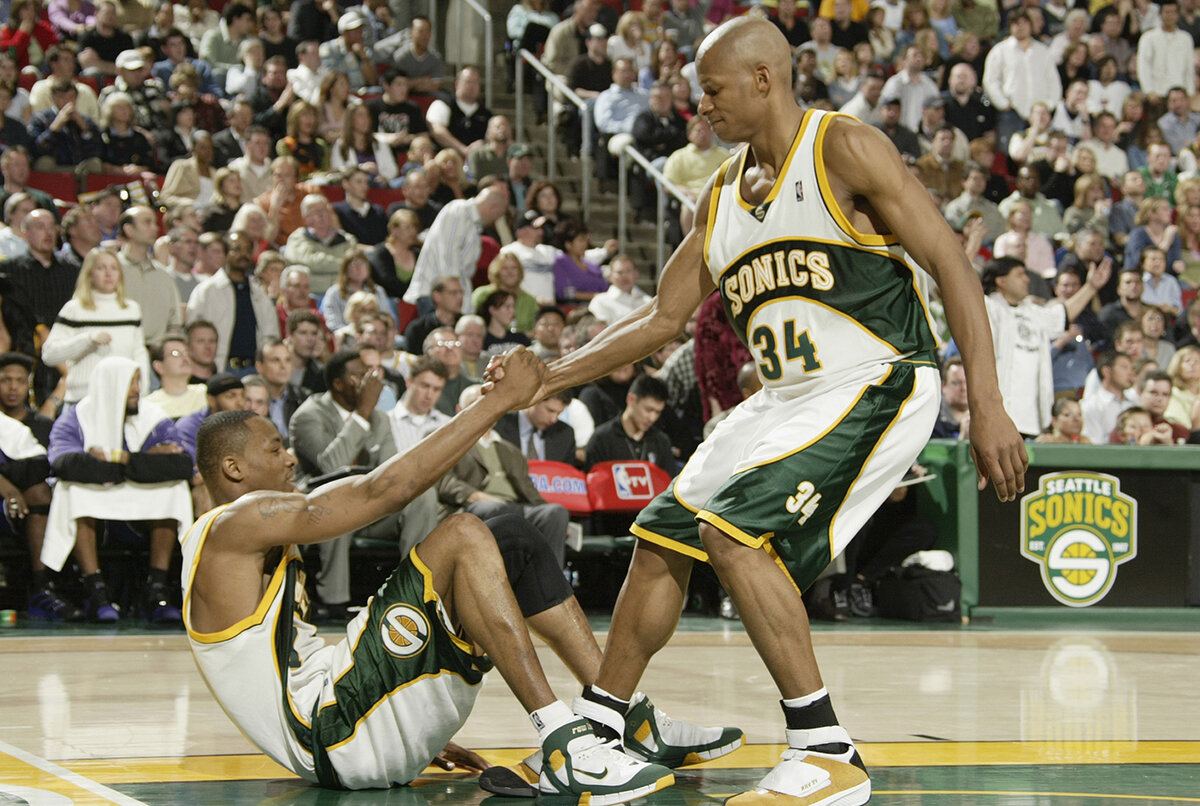
Ray Allen made six three-pointers in Seattle’s Game 4 win over Sacramento in 2005. They accounted for 18 of his 45 points. The other 27 are a useful reminder of how much of that Sonics performance happened somewhere other than behind the arc.
Allen finished 17-for-28 from the field and made all five of his free throws, according to his historical playoff game log. Seattle won 115–102 on May 1, taking a 3–1 series lead. The official Sacramento media guide preserves that result in its 2004–05 playoff record.
Eleven made twos belong in the picture
Subtract Allen’s six made threes from his 17 made field goals and there are 11 two-point baskets left. They supplied 22 points, four more than his threes produced. Five free throws completed the total.
The shot distribution is equally revealing. Fourteen of his 28 field-goal attempts were threes, leaving 14 attempts from two-point range. He made 11 of those 14 twos. His night combined volume from distance with exceptional conversion inside the arc.
That does not tell us where every two-pointer originated or how every defender reacted. A box score cannot reliably distinguish a contested jumper from an open finish. It does establish that describing the game only as a three-point barrage leaves out the larger share of Allen’s scoring.
For anyone learning Allen through his reputation as a shooter, the distinction makes Seattle’s tape worth seeking out. Watch the possessions that produce two points with the same attention as the long-range makes. The scoring totals give viewers a clear reason to look beyond the most familiar highlight.
Put Game 4 back in the series
Seattle had won the first two games at home before Sacramento answered in Game 3. The Kings’ official historical schedule then records the Sonics’ Game 4 road win and a 122–118 Seattle victory in Game 5. The sequence matters: Allen’s 45-point night put Seattle one win from advancing, but the series still required another result.
The Kings’ official playoff record confirms Seattle finished the series 4–1. Keeping those games separate protects the actual achievement. Game 4 was the road win that changed the situation; Game 5 completed the job at home.
There is a wider lesson in the different scores. Seattle’s wins included the 87–82 opener as well as the 122-point clincher. A series can ask a team to survive very different kinds of games, and a single memorable scoring performance should not erase the other work required to advance.
Read the 45 without inventing a different game
Allen scored 45 of Seattle’s 115 points, about 39 percent. That calculation describes his share of the recorded total. It does not mean removing him from the lineup would simply subtract 45 points and leave everything else unchanged. Another player would take minutes and shots, and both teams would make different choices.
The strongest historical claim needs no such hypothetical. Allen delivered a huge individual night within a real Sonics playoff win, and the box score shows several ways he did it.
His six threes deserve their place in Seattle’s memory. So do the 11 made twos and the perfect five attempts at the line. Together, they tell a fuller story of the player the Sonics relied on in Sacramento.
For more context, read The Complete History of the Seattle SuperSonics—and Why the NBA May Finally Be Coming Back and Freddie Brown’s 39 Threes Tell Only Part of Seattle’s Shooting History.
Sources
Basketball-Reference — Ray Allen playoff game log; Sacramento Kings official 2024–25 media guide — 2004–05 playoffs, page 221; ESPN — Seattle at Sacramento, May 1, 2005 box score; ESPN — Sacramento at Seattle, May 3, 2005 box score.
Image: Ray Allen with Seattle teammates; archival illustration, not labeled as the May 1 game. Via Sonics Forever.