Seattle made nine more field goals than Phoenix in Game 7 of the 1993 Western Conference finals and still lost by 13 points. For Sonics fans revisiting that afternoon, the apparent contradiction disappears when the scoring is separated into its parts.
The historical box score records a 123–110 Phoenix victory on June 5, 1993. Seattle shot 39-for-78 from the field; Phoenix went 30-for-72. The difference was built largely at the free-throw line, where the Suns made 57 shots and Seattle made 28.
What the scoreboard actually contains
A made field goal is worth two or three points. Seattle’s 39 baskets included four threes, producing 82 points from the floor: 35 two-point baskets for 70 points, plus 12 points from behind the arc.
Phoenix’s 30 baskets included six threes. That produced 66 floor points: 24 twos for 48, plus 18 from long distance. Seattle therefore held a 16-point advantage in points scored from the field.
The foul line reversed it. Phoenix’s 57 free throws exceeded Seattle’s 28 by 29. Subtract the Sonics’ 16-point floor advantage from that 29-point gap and the result is the final 13-point margin. The Suns’ official historical account also records their 57-for-64 free-throw shooting and the 123–110 final score.
This arithmetic is descriptive. It identifies where the points came from, without assuming the game would have unfolded identically if a whistle, a miss or a substitution had changed.
Attempts and accuracy are separate questions
Phoenix attempted 64 free throws and Seattle attempted 36. The Suns also converted a larger share of those attempts. Those are two separate advantages: more opportunities at the line and better conversion once there.
It is tempting to turn the totals into a verdict on the officiating. The box score cannot supply that verdict. Evaluating a particular call requires the play itself, the rule that applied and the contact or action being judged. A disparity tells a viewer where to investigate; it does not establish that every extra attempt was improper.
The reverse shortcut is just as weak. A final score cannot prove that every decision was correct. Remembering the game carefully means leaving room for a play-by-play review without treating a numerical imbalance as proof of intent.
Seattle also lost the rebounding count
The corroborating game record gives Phoenix 46 rebounds to Seattle’s 31, including a 16–8 edge on the offensive glass. Rebounding belongs in the account alongside the foul-line totals. An offensive rebound can extend a possession after a miss, creating another opportunity for a team that has just failed to score.
Those columns cannot establish how many additional points came directly from the extra rebounds. Nor should eight more offensive rebounds automatically be described as eight separate scoring possessions. They identify another concrete part of the game that a full replay could examine.
For Seattle, this is what makes the loss worth studying beyond its most frequently repeated number. Better field-goal shooting did not cover every route through which Phoenix could create and finish scoring chances.
Keep the basketball in the memory
A useful rewatch would track three things: how each trip to the line began, what happened after a missed shot and where Seattle created its made baskets. That produces a more informative account than repeatedly announcing the free-throw total.
The Sonics lost a chance to reach the Finals. Their Game 7 deserves a precise record of how it happened, with the scoring arithmetic clear and conclusions about individual plays earned by the evidence.
For more context, read The Complete History of the Seattle SuperSonics—and Why the NBA May Finally Be Coming Back and Nate McMillan’s 1993–94 Season Deserves More Than a Footnote.
Sources
Basketball-Reference — June 5, 1993 Game 7 box score; Land of Basketball — complete Game 7 statistical record; Phoenix Suns — clinching the 1993 Western Conference title; Scott Howard-Cooper, Los Angeles Times — contemporaneous Game 7 report.
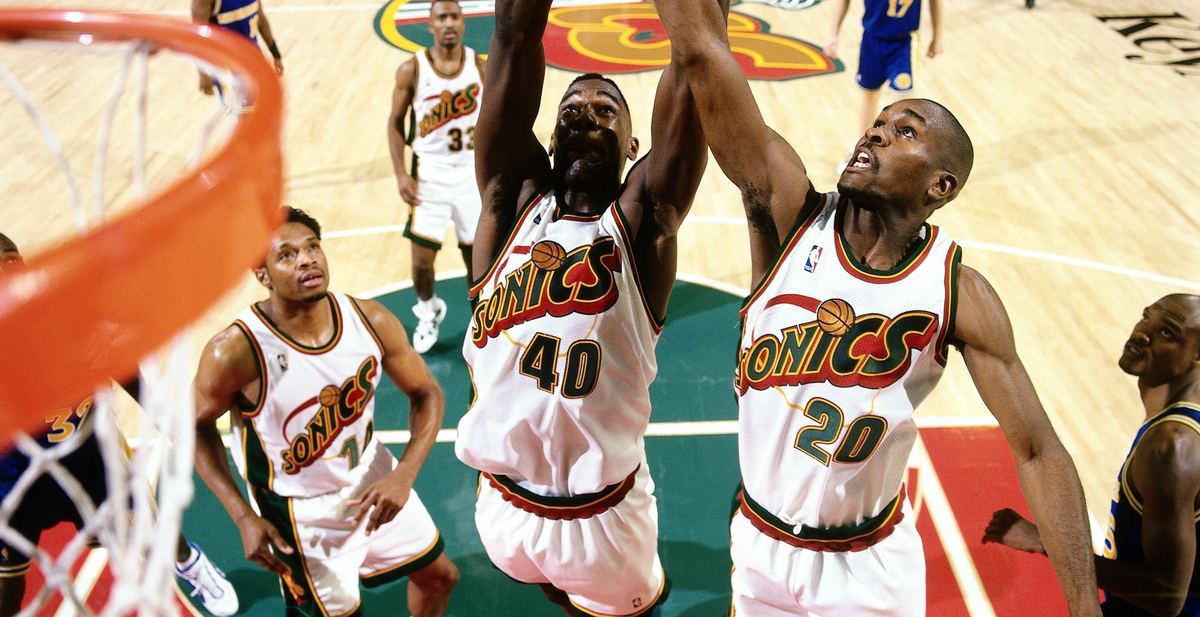
Image: Sonics-era basketball illustration; not a photograph of the 1993 Game 7. Via SB Nation.