From the Amazon #1 Best Selling Author (ModernMillions.ai), R. Kenner French
Vin Baker’s first season in Seattle deserves to be read in the present tense of 1997–98, not only through everything that happened afterward. The Sonics won 61 games that year. Baker made the All-NBA second team, while Gary Payton earned first-team recognition.
The NBA’s season review records Seattle’s 61–21 finish. Its historical All-NBA list identifies both selections. Together, those records provide a useful starting point: this was a successful Seattle regular season with two players receiving substantial league recognition.
That does not settle every argument about the roster. It does mean the year should not disappear into a simplified before-and-after account of the Sonics’ frontcourt.
A November scoring example
On November 6, 1997, Baker scored 35 points against Toronto, making 14 of 20 field-goal attempts and seven free throws. Payton finished with 19 points and 13 assists in the NBA’s game record.
Baker’s scoring arithmetic is straightforward: 28 points from field goals and seven at the line. He attempted no threes. The performance therefore illustrates a different route to a big offensive night from the perimeter-heavy formula that dominates many modern discussions.
It does not establish where every two-point attempt came from. The box score alone cannot divide those makes into post moves, cuts, putbacks or jumpers. Nor does Payton’s assist total tell us how many of Baker’s baskets he supplied. Those are questions for play-by-play or film, not details to invent because the partnership looks obvious on paper.
What the numbers do establish is that Seattle could get a large scoring return from Baker while Payton filled both scoring and distribution columns. That is a concrete basketball reason to revisit this particular team, rather than treating it as a placeholder between more familiar Sonics memories.
The other end of the season
Against Portland on April 19, Baker recorded 20 points and 10 rebounds. Six of the rebounds were offensive. He also went 4-for-10 at the foul line, as the official box score shows.
That is a more complicated line than a celebratory highlight. Offensive rebounds represent recovered opportunities, but six missed free throws represent points left available. Both belong in an honest account. A player’s useful work and a weakness can occupy the same game without canceling each other out.
The contrast with November is instructive. Toronto supplies a high-efficiency shooting night; Portland supplies a double-double with a conspicuous foul-line cost. Neither should be stretched into the entire season. Together they make the portrait less dependent on a single adjective such as dominant or disappointing.
Recognition without rewriting the ending
All-NBA honors are voting outcomes, not a possession-by-possession audit. A 61-win team record is a team accomplishment, not something to credit entirely to one arrival. Keeping those limits clear actually strengthens the case for remembering Baker’s year fairly.
Seattle’s basketball history contains seasons that were excellent without becoming championships. It also contains players whose strongest local stretch can be overshadowed by a later narrative. Separating those questions is not nostalgia at the expense of accuracy. It is accuracy applied to chronology.
For Baker, the 1997–98 evidence is substantial enough to merit its own chapter: a prominent Seattle role, a major individual honor and a high-winning team. That chapter does not need to answer every question about his career to be worth reading.
Related reading
For more Seattle basketball context, read Shawn Kemp’s Second Sonics Season Was a Leap in Responsibility and George Karl Built a Six Season Standard in Seattle.
Sources
NBA History: 1997-98 Season Review — NBA.com Staff / NBA; NBA History: All-NBA Teams — NBA; SuperSonics vs. Raptors, November 6, 1997 box score — Sports Reference / Basketball-Reference; Seattle SuperSonics at Toronto Raptors game page — ESPN; SuperSonics vs. Trail Blazers, April 19, 1998 box score — Sports Reference / Basketball-Reference; NBA official box score: Seattle SuperSonics at Portland Trail Blazers, April 19, 1998 — NBA.
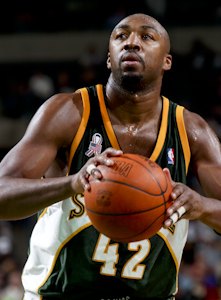
Image: Vin Baker; archival player photograph, not a photograph from either game discussed. Photo: Lipofsky Basketballphoto.com. CC BY 3.0. Resized when needed and compressed; no visual content added. Lipofsky Basketballphoto.com.
