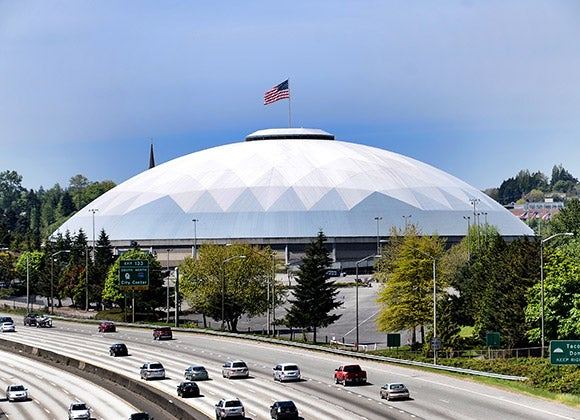
The Seattle SuperSonics’ home arena for the 1994–95 season was in Tacoma. The team’s temporary stay at the Tacoma Dome belongs in the story of both cities, and in any careful account of the building that became KeyArena.
A 2015 arena report prepared for Seattle identifies the Sonics’ temporary Tacoma tenancy while their Seattle arena was renovated. The season’s historical team record also lists the Tacoma Dome as its arena.
That simple location change is easy to lose when a franchise’s history is organized only by players and wins. A team can keep its name and its roster while the practical meaning of attending a home game changes considerably.
The Seattle building was being rebuilt
Seattle’s KeyArena history brief traces the project to a 1993 revenue-sharing lease negotiation. Modernizing the Coliseum and retaining the Sonics as its anchor sports tenant were central purposes of the work.
This was a substantial construction project. The city’s account describes increasing capacity within the existing footprint and roofline and lowering the building by 35 feet. The total project cost was $104 million, including a $21 million Sonics contribution for specified facilities and improvements.
Those historical figures describe that project. They are not estimates for a current arena, a proposed expansion team or a future NBA return. Their value here is explaining why the Sonics needed another place to play while Seattle’s building was transformed.
The same city account places KeyArena’s opening in October 1995. That creates a clear sequence: a reconstruction project, a temporary Tacoma season and the opening of the renovated Seattle venue.
Home is also a set of logistics
For fans, a home game involves more than the designation printed beside a fixture. It means a route, an arrival time, a seat and a trip back afterward. Moving that routine to another city changes the experience even when the jerseys remain familiar.
The record does not tell us that every fan found the change inconvenient, or that every Tacoma resident suddenly became a Sonics follower. Both claims would require evidence from people who attended. What the location establishes is that the team’s home schedule took place in a different part of the region.
That distinction makes Tacoma an essential stop in a Sonics history project. Tickets, programs and photographs from the season should be identified by their actual venue. Labeling every mid-1990s home image as KeyArena can place a real memory in the wrong building.
Separate the venue from the result
It is also important not to treat a temporary arena as a ready-made explanation for everything a team did. Proving that a venue changed performance would require much more than showing that the Sonics played there. Opponents, lineups, injuries and ordinary variation all affect results.
The strongest story is already concrete: a major-league team kept playing while its Seattle home underwent substantial work, and Tacoma supplied the temporary home. That is a regional basketball fact worth preserving without an unsupported theory about wins, losses or crowd psychology.
When the Sonics’ past is reduced to the championship, the stars and the departure, this season can slip between the larger chapters. Remembering Tacoma restores an important piece of how the team actually operated, and where its fans actually went to watch.
For more context, read The Complete History of the Seattle SuperSonics—and Why the NBA May Finally Be Coming Back and Where Would a New Seattle SuperSonics Team Play?.
Sources
AECOM for Seattle City Council — KeyArena options report, June 2015; City of Seattle — KeyArena history and background brief; Basketball-Reference — 1994–95 Seattle team record.
Image: Tacoma Dome exterior; illustrative venue photograph, not dated to the 1994–95 season. Via Tacoma Dome.