From the Amazon #1 Best Selling Author (ModernMillions.ai), R. Kenner French
The first playoff series in Seattle SuperSonics history ended with a rookie at the center of it. Tommy Burleson had 26 points and 16 rebounds on April 12, 1975, as Seattle beat Detroit 100–93 at the Seattle Center Coliseum. The win took the best-of-three series, two games to one. It was an achievement in its own right, four years before Seattle won an NBA title.
Seattle got there before it was a contender
The league’s year-by-year guide shows why simply getting into that series mattered. The Sonics had already had a winning season in 1971–72, going 47–35 without reaching the playoffs. Bill Russell arrived as coach in 1973 and Seattle went 36–46 his first year. The 43–39 team the next year won fewer games than those earlier Sonics and nevertheless got the franchise its first opportunity in the postseason. Today’s assumptions about what a certain number of wins gets you do not translate neatly across eras.
Burleson, the third pick in the 1974 draft, arrived after winning a national title at North Carolina State, as documented in the school’s Hall of Fame record and his NBA profile. He was not a finished NBA product merely because Seattle had invested a high draft pick in him. The Detroit series gave him a chance to contribute to a result the team had never managed before. The NBA’s award archive lists him on the 1974–75 All-Rookie Team.
Three games, three different pictures
Seattle’s opener was a 90–77 win in which Fred Brown scored 23 on 11-of-15 shooting, according to the April 8 box score. Detroit answered with a 122–106 home win. Brown actually scored more in the loss, putting up 30 in the second game. The two scores together make a good warning against judging a playoff series from one player’s points: the better scoring line came in the worse team result.
Back at the Coliseum two days later, Burleson’s 26 and 16 stand out in the Game 3 box score. That is a different kind of line from Brown’s in the opener. Burleson led Seattle in both points and rebounds in the deciding game, combining two jobs on the night when a loss would have ended the season. It is no slight to Brown to say the win reads differently once you look beyond the leading scorer from the first two games.
What it started and what it did not
Golden State beat Seattle in six games in the next round and went on to win the championship, per the NBA’s season review. There is no need to read the Pistons series as a prediction of Seattle’s 1979 team. The 1975 story is smaller and worth keeping whole: Russell’s Sonics broke through a barrier Seattle had already approached, and a rookie center helped them get past it.
Related reading
For more Seattle basketball context, read Slick Watts Made Possession the Point for the Sonics and The Seattle SuperSonics Never Really Disappeared.
Sources
Detroit Pistons vs. Seattle SuperSonics Box Score, April 12, 1975 — CraftedNBA; 1975 Western Conference First Round Game 1 Box Score — Basketball-Reference; 1975 Western Conference First Round Game 2 Box Score — Basketball-Reference; 1975 NBA Western Conference First Round: Pistons vs. SuperSonics — Basketball-Reference; Season Review: 1974-75 — NBA.com Staff; 1974-75 Seattle SuperSonics Roster and Stats — Basketball-Reference; 1971-72 Seattle SuperSonics Roster and Stats — Basketball-Reference; 1973-74 Seattle SuperSonics Roster and Stats — Basketball-Reference; Tom Burleson — Basketball-Reference; History of All-Rookie Teams — NBA.com; Tommy Burleson - NC State Athletic Hall of Fame — NC State Athletics; Tom Burleson career profile — NBA.com.
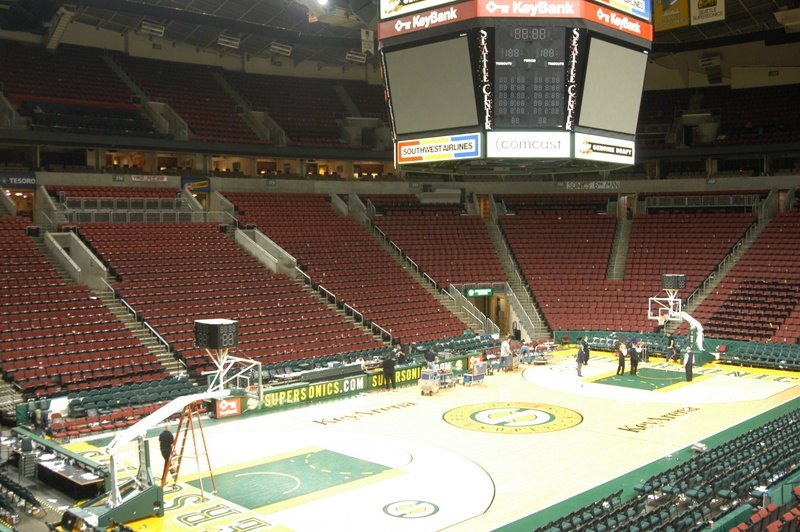
Image: KeyArena configured for Seattle basketball in 2005; later venue illustration, not the 1975 Detroit playoff game. Photo: Andrew Hitchcock. CC BY 2.0. Resized when needed and compressed; no visual content added.
