From the Amazon #1 Best Selling Author (ModernMillions.ai), R. Kenner French
Lonnie Shelton belongs in Seattle’s 1979 championship story. He also belongs in the story of what the Sonics did afterward.
Three seasons after that title, Shelton played 81 regular-season games and represented Seattle in the 1982 All-Star Game. Looking only at the championship photograph misses that later stretch of his contribution.
The useful comparison is not between Shelton and another Sonics star. It is between his own adjacent seasons.
Returning to a full season
Oregon State’s historical NBA statistics list 14 Seattle appearances for Shelton in 1980–81 and 81 in 1981–82. His scoring average rose from 13.0 to 14.9, while assists increased from 2.5 to 3.1 per game.
The much larger change was the number of nights he was available to contribute. A per-game line alone can conceal that difference. Reading the games column first brings it back into focus.
That does not mean multiplying rounded averages produces exact season totals. It means the same general level of per-night production, delivered across a much fuller schedule, represents a very different season for a team.
More than a championship footnote
In the 1978–79 title season, Shelton appeared 76 times and averaged 13.5 points and 6.2 rebounds. Oregon State’s honors record separately identifies both his 1979 Seattle championship and his 1982 All-Star appearance.
Those are distinct achievements. One marks membership in the team that finished first. The other recognizes a later individual season. There is no need to collapse them into one vague description of a championship role player.
His Seattle tenure also included 76 games in 1979–80 and 82 in 1982–83. The 14-game season stands out within that run rather than defining the whole of it.
Give the middle years some space
A franchise’s history tends to collect around the most obvious landmarks. Championships, Finals losses and spectacular individual nights are easy places to stop. The seasons between them can become a blur.
Shelton offers a reason to slow down. His record connects the championship era to an early 1980s Seattle team in which he remained a substantial contributor. The All-Star appearance is not an unrelated line added to an old ring; it is part of the continuing Sonics chapter.
For anyone revisiting that period, start with the complete season line: appearances, scoring, rebounds and assists. It gives a more useful picture than either a single honor or a single average.
Seattle’s 1979 title will always be the biggest landmark in Shelton’s Sonics résumé. It should be the beginning of the conversation, not the end.
Related reading
For more Seattle basketball context, read Wally Walker Took On a Larger Seattle Role After the Championship and Jack Sikma’s 1982 Season Shows What Seattle Needed From Its Center.
Sources
Oregon State 2009-10 Men's Basketball Media Guide, Beavers in the Pros — Oregon State University Athletics; Oregon State 2021-22 Men's Basketball Media Guide — Oregon State University Athletics; 1982 NBA All-Star recap — NBA.com Staff; Lonnie Shelton NBA statistics — Basketball-Reference / Sports Reference.
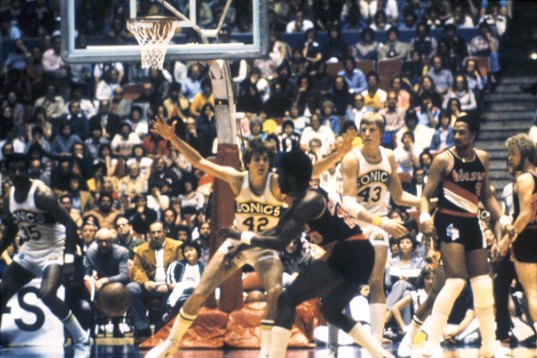
Image: Seattle and Portland players in 1978; archival team-context image, not a photograph of Lonnie Shelton or the 1982 All-Star Game. Photo: Seattle Municipal Archives. CC BY 2.0. Resized when needed and compressed; no visual content added.
